Introduction to LLM
This page provides an easy-to-understand guide on LLMs (Large Language Models) from basics to applications for AI enthusiasts.
2.1 What Is a Large Language Model?
A clear and in-depth explanation of what Large Language Models (LLMs) are. Learn how LLMs map token sequences to probability distributions, why next-token prediction unlocks general intelligence, and what makes a model “large.” This section builds the foundation for understanding pretraining, parameters, and scaling laws.
2025-09-08Chapter 2 — LLMs in Context: Concepts and Background
An accessible introduction to Chapter 2 of Understanding LLMs Through Math. Explore what Large Language Models are, why pretraining and parameters matter, how scaling laws shape model performance, and why Transformers revolutionized NLP. This chapter provides essential context before diving deeper into the mechanics of modern LLMs.
2025-09-071.2 Basics of Probability for Language Generation
An intuitive, beginner-friendly guide to probability in Large Language Models. Learn how LLMs represent uncertainty, compute conditional probabilities, apply the chain rule, and generate text through sampling. This chapter builds the mathematical foundation for entropy and information theory in Section 1.3.
2025-09-051.1 Getting Comfortable with Mathematical Notation
A clear and accessible guide to understanding the mathematical notation used in Large Language Models. Learn how tokens, sequences, functions, and conditional probability expressions form the foundation of LLM reasoning. This chapter prepares readers for probability, entropy, and information theory in later sections.
2025-09-04Chapter 1 — Mathematical Intuition for Language Models
An accessible introduction to Chapter 1 of Understanding LLMs Through Math. Learn how mathematical notation, probability, entropy, and information theory form the core intuition behind modern Large Language Models. This chapter builds the foundation for understanding how LLMs generate text and quantify uncertainty.
2025-09-03Part I — Mathematical Foundations for Understanding LLMs
A clear and intuitive introduction to the mathematical foundations behind Large Language Models (LLMs). This section explains probability, entropy, embeddings, and the essential concepts that allow modern AI systems to think, reason, and generate language. Learn why mathematics is the timeless core of all LLMs and prepare for Chapter 1: Mathematical Intuition for Language Models.
2025-09-02Understanding LLMs – A Mathematical Approach to the Engine Behind AI
A preview from Chapter 7.4: Discover why large language models inherit bias, the real-world risks, strategies for mitigation, and the growing role of AI governance.
2025-09-01
7.3 Integrating Multimodal Models
A preview from Chapter 7.3: Discover how multimodal models fuse text, images, audio, and video to unlock richer AI capabilities beyond text-only LLMs.
2024-10-09
7.2 Resource-Efficient Training
A preview from Chapter 7.2: Learn how techniques like distillation, quantization, distributed training, and data efficiency make LLMs faster, cheaper, and greener.
2024-10-08
2.3 Key LLM Models: BERT, GPT, and T5 Explained
Discover the main differences between BERT, GPT, and T5 in the realm of Large Language Models (LLMs). Learn about their unique features, applications, and how they contribute to various NLP tasks.
2024-09-10
2.2 Understanding the Attention Mechanism in Large Language Models (LLMs)
Learn about the core attention mechanism that powers Large Language Models (LLMs). Discover the concepts of self-attention, scaled dot-product attention, and multi-head attention, and how they contribute to NLP tasks.
2024-09-09
2.1 Transformer Model Explained: Core Architecture of Large Language Models (LLM)
Discover the Transformer model, the backbone of modern Large Language Models (LLM) like GPT and BERT. Learn about its efficient encoder-decoder architecture, self-attention mechanism, and how it revolutionized Natural Language Processing (NLP).
2024-09-07
2.0 The Basics of Large Language Models (LLMs): Transformer Architecture and Key Models
Learn about the foundational elements of Large Language Models (LLMs), including the transformer architecture and attention mechanism. Explore key LLMs like BERT, GPT, and T5, and their applications in NLP.
2024-09-06
1.3 Differences Between Large Language Models (LLMs) and Traditional Machine Learning
Understand the key differences between Large Language Models (LLMs) and traditional machine learning models. Explore how LLMs utilize transformer architecture, offer scalability, and leverage transfer learning for versatile NLP tasks.
2024-09-05
1.1 Understanding Large Language Models (LLMs): Definition, Training, and Scalability Explained
Explore the fundamentals of Large Language Models (LLMs), including their structure, training techniques like pre-training and fine-tuning, and the importance of scalability. Discover how LLMs like GPT and BERT work to perform NLP tasks like text generation and translation.
2024-09-03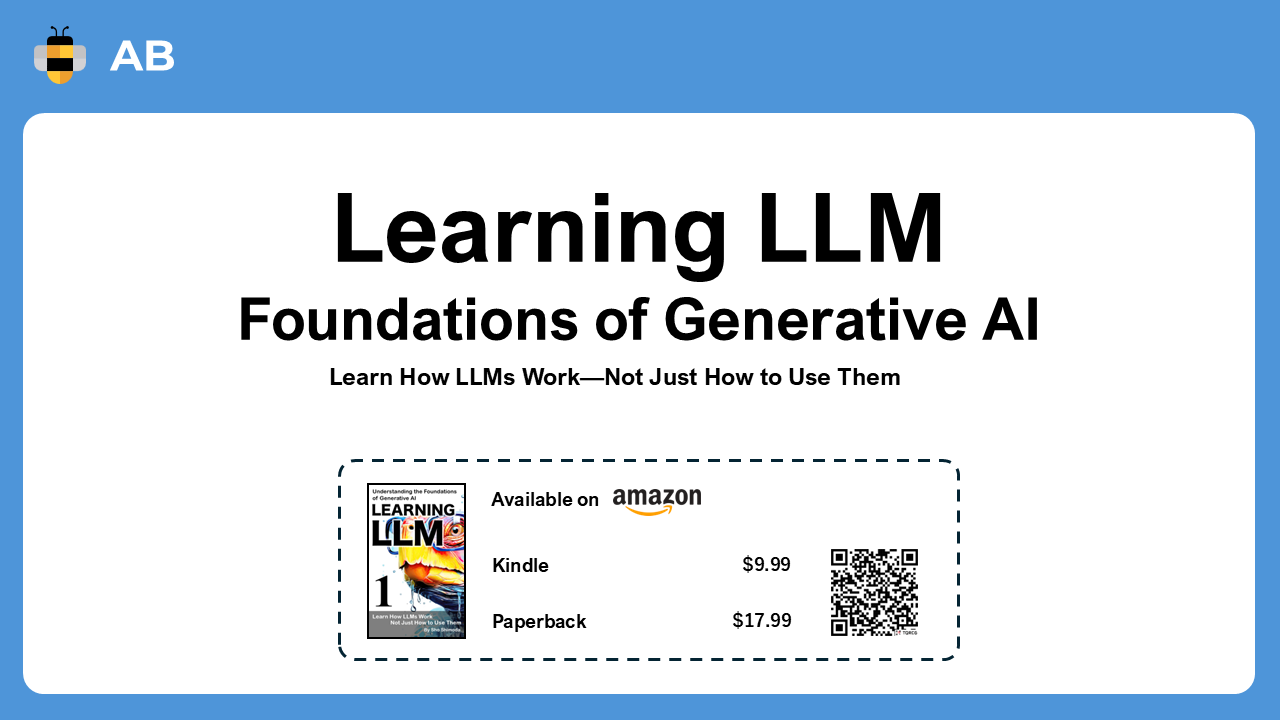
A Guide to LLMs (Large Language Models): Understanding the Foundations of Generative AI
Learn about large language models (LLMs), including GPT, BERT, and T5, their functionality, training processes, and practical applications in NLP. This guide provides insights for engineers interested in leveraging LLMs in various fields.
2024-09-01